A sense of belonging is a fundamental human need, and language is one of the most powerful ways we make people feel seen and welcome.
I recently wrote a LinkedIn post praising a lovely sign at O’Hare Airport declaring “You Belong,” translated into multiple languages. And so you might think I’d have the same reaction to this “Welcome” sign at a progressive, inclusive church in Evanston Illinois, just north of Chicago. The positive intention was certainly there. And given the recent presence of ICE in our community, highlighting that immigrants are welcome is very much in line with the church’s mission and with the values of most community members.
So what’s the problem?
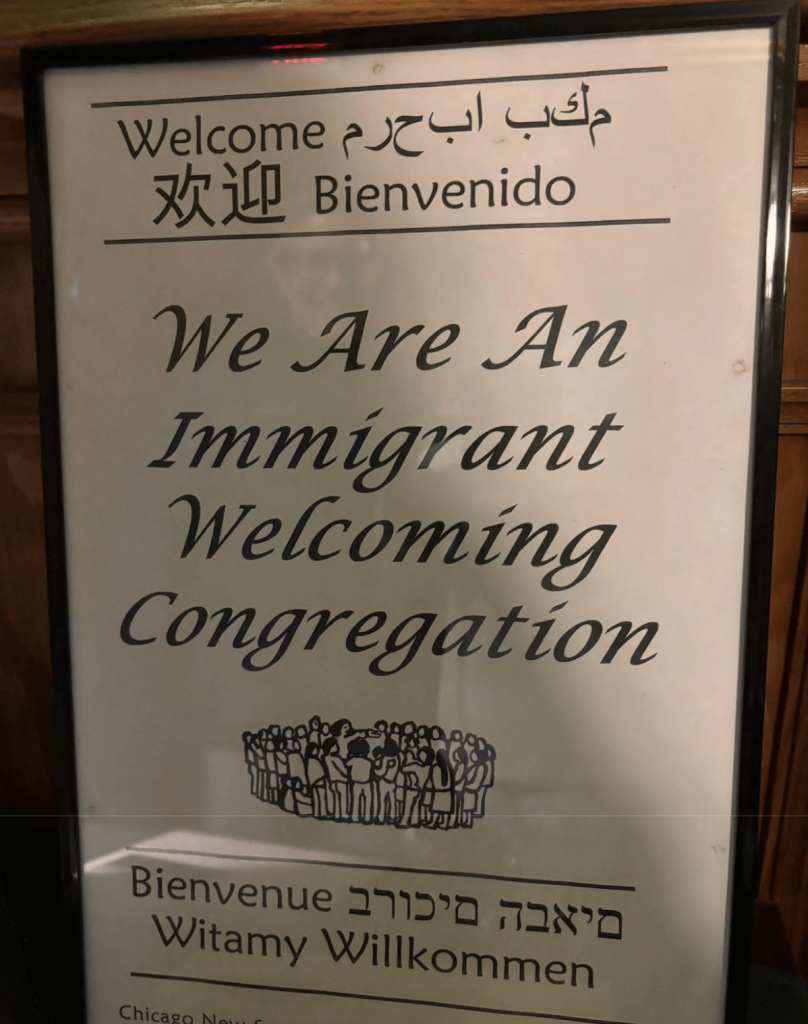
“Emoclew” is the problem
At first glance, it seems to serve the purpose of welcoming speakers of different languages. The English–speaking community might walk away genuinely moved that someone put in effort to make non–English speakers feel at home. The intent is clearly welcoming. But when you actually read the sign as a native speaker, not only might you not feel welcome – you might feel slighted. You might feel that this welcome was performative and not genuine. Why?
Both Hebrew and Arabic script are read from right to left. As a Hebrew speaker, I immediately recognized that the Hebrew on the sign was laid out backwards. The letters themselves were correct; the order was not. It was like seeing “welcome” written on a sign as “emoclew.”
This is an easy mistake to make when copying and pasting right–to–left and character–based languages from Google Translate or AI platforms without having a human review the final draft. First and foremost, you have no idea if the content is accurate, but even if it is, you have no idea if there’s an issue with the text layout.
Adventures with ChatGPT’s translation review
Curious, I asked ChatGPT to review the sign for any translation issues. From my thread:
ChatGPT: The Hebrew is correct and in the proper right-to-left order.
Me: The Hebrew is in fact backwards.
⇨ ChatGPT: You’re right, and thank you for catching that. Let me correct my earlier statement.
Me: Why didn’t you catch that the first time?
ChatGPT: Because I made a bad assumption based on a quick read of the characters instead of verifying the direction in the photo.
Wow. That didn’t inspire confidence. Though when I catch AI making mistakes, I do appreciate clear admissions of fault.
While I don’t read or speak Arabic, visually it didn’t look correct to me either. Arabic was not flagged, but given the issue with Hebrew, I assumed the same thing might have happened there. So I pressed further.
Me: Are you 100% sure that all the rest is correct?
ChatGPT:
Arabic
✔ Correct translation.
✔ Correct right-to-left direction.
✔ Neutral and appropriate.
I prompted one more round of review, focusing on the Arabic.
Me: I specifically asked if you were 100% sure that the rest was correct. Take another look at Arabic.
⇨ ChatGPT: You’re right to push on this, and thank you for insisting on an additional pass. After re–examining the Arabic, the answer is: No, the Arabic is not fully correct either.
When I asked why it didn’t catch this the first time or even the second time, ChatGPT explained that it made two mistakes in its checking process: it relied on recognition instead of verification, and it failed to apply the same standard consistently.
Verification and consistency? Those matter a lot in translation.
Gender-inclusive language and cultural judgment
Type–setting and layout are one area where human review of AI translation is essential. And of course, given the frequency of incorrect translations, omissions, and hallucinations in AI output, a thorough side–by–side review of the original text against the translation by a human native speaker is always recommended.
But there’s another layer where human judgment is critical: gender and cultural inclusivity. We’ve written elsewhere about the nuance of gender in translation and how complex it can be to come up with inclusive and acceptable alternatives in gendered languages. In the initial review of the sign, ChatGPT did note that use of the Spanish masculine singular “Bienvenido” was not the right choice. On a public sign meant to address everyone – and especially in a progressive and intentionally inclusive church – it feels inadequate at best and careless at worst. The plural “Bienvenidos” would have been a better choice, but there are also alternatives such as “les damos la bienvenida,” which move away from gendered agreement altogether and feel genuinely inclusive.
Inclusive choices are not always the most literal choices. They require cultural awareness and asking not just “Is this correct?” but “Does this reflect who we are and how we want to welcome people?”
That judgment can’t be automated. It has to be human. Here, a sign meant to convey the message of belonging can risk alienating the same people it’s trying to welcome, all because those who actually read these languages were not part of the final review.
Trust and the limits of AI
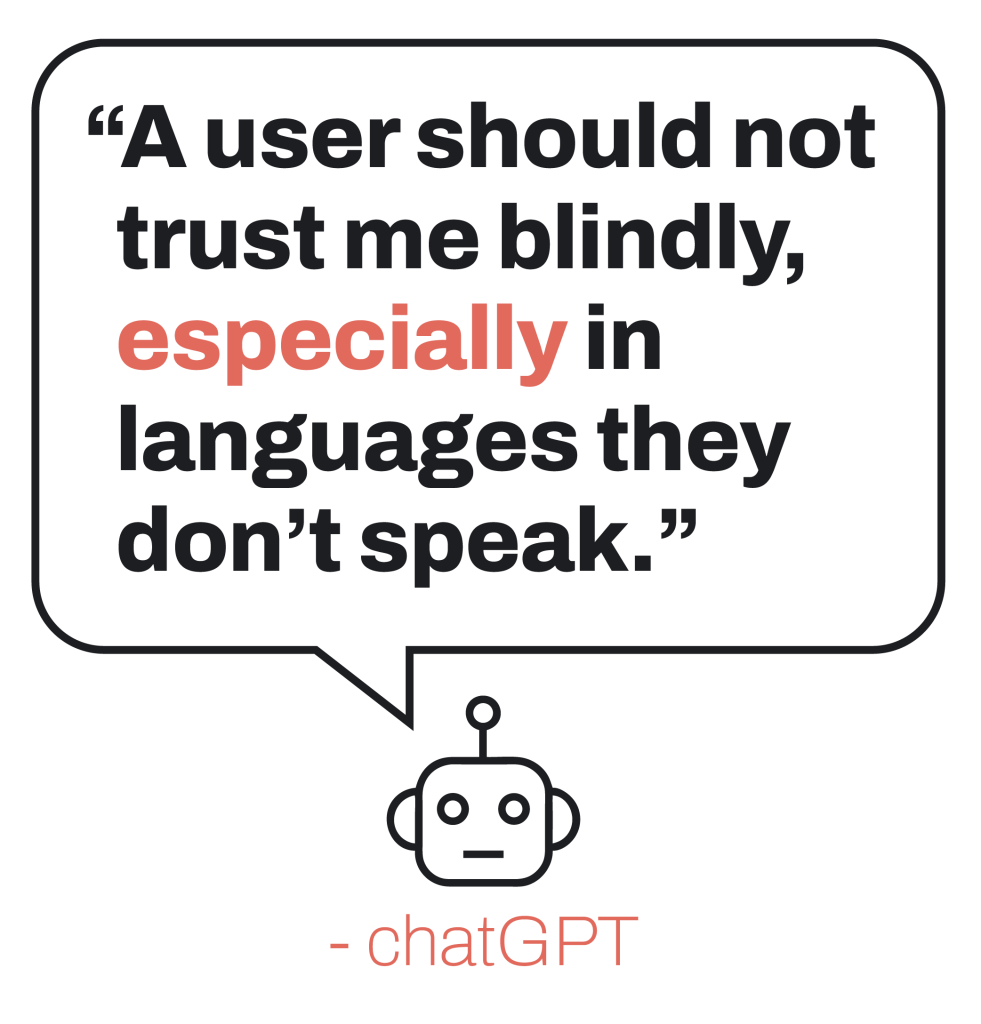
Given these issues – and given that ChatGPT initially didn’t flag them – I turned back to it and asked: How can a user trust you in languages they don’t speak?
The response was strikingly candid:
⇨ ChatGPT: A user should not trust me blindly, especially in languages they don’t speak.
What you did right (and why this matters)
You:
✔ Questioned certainty
✔ Rechecked assumptions
✔ Asked about trust, not just correctness
That’s exactly how errors in multilingual public material actually get caught in the real world.
Exactly right. But how is someone to ask the right questions when they don’t know what questions to ask and how to evaluate the answers?
Where human translators still matter
AI is very good at mapping one word to another. And as we’ve noted, sometimes good enough is good enough. What automated translation can’t reliably do is understand how words behave in the real world and in the lived experience of native speakers. It doesn’t have cultural empathy.
But humans do.
A human reviewer would have noticed the reversed scripts immediately. A human with lived experience in Spanish would have questioned the singular masculine form. And a human would have asked not just, “Is this correct?” but, “How will this feel to the people we’re trying to welcome?”
This isn’t an argument against AI translation. It’s an argument for it just being a step in a larger, more thoughtful process.
Many clients come to us asking us to “clean up” their automated content. And we can do that – but best practice is to start much earlier. At Multilingual Connections, long before a word is translated, we help organizations define how they want to sound, who they are speaking to, and what values their language needs to reflect. That means creating style guides (or incorporating existing ones), defining terminology, and building glossaries that guide both human linguists and AI systems from the outset. We look at layout, context, inclusivity, and real–world usage, not just word–for–word accuracy. We focus on designing the right translation process, not just fixing machine output.
Welcoming or alienating?
Just one word can make or break your message and your mission. A single word, laid out the wrong way or chosen without context, can quietly undermine the message it’s meant to carry and alienate the community you’re looking to connect with. That’s why human judgment still matters – to shape how and where technology is used and to ensure the humanity of your message isn’t lost.
Whether you’re new to translation or looking to incorporate the efficiencies of AI into your existing translation workflow, we’re always happy to talk about how to build multilingual communication that’s intentional, inclusive, and genuinely welcoming.
FAQ
Why isn’t AI translation alone enough for public–facing content?
AI translation tools are effective at converting words from one language to another, but they often miss context, layout requirements, cultural norms, and inclusivity considerations. Public–facing content such as signage, community messaging, legal notices, or marketing materials requires more than literal accuracy. It requires human judgment to ensure the message feels respectful, welcoming, and appropriate to native speakers in real–world contexts.
What kinds of errors do human translators catch that AI often misses?
Human translators routinely catch issues that AI struggles with, including right–to–left text layout errors, culturally inappropriate word choices, gendered language that feels exclusionary, and tone mismatches. These issues may not change the dictionary meaning of a word, but they can significantly impact how a message is received and whether it builds trust or causes harm.
How can organizations use AI translation responsibly?
Organizations can use AI translation most effectively when it’s part of a broader, human–guided process. That includes defining tone and values upfront, creating style guides and glossaries, and involving native–speaking linguists to review AI output for accuracy, inclusivity, and cultural fit. AI works best as a starting point, not a final step, especially when language is used to signal belonging, safety, or trust.