You’re in the produce section at the grocery store looking at strawberries. You grab a pint of plump, bright red berries, but when you get home you discover that the bottoms are covered in white fuzz. You couldn’t see that from the outside, but when you open the container and look underneath, you see it. That may not be a big deal if you were going to use them for your smoothie: cut off the mold, toss them in the blender, good enough.
But what if you were planning to dip them in chocolate and serve them as dessert? Sometimes good enough is good enough, but sometimes that standard falls short. Your needs dictate what’s acceptable in each situation.
And the same is true for translation.

Hidden Mold: The “Good Enough” Blind Spot
In many areas of our professional lives, we’re conditioned to hunt for errors and blind spots. We test, validate, and stress-test to ensure accuracy. Those of us who have worked with AI for a while know this well – we’ve learned to expect errors, hallucinations, or omissions and to push back when something doesn’t look right. And the same platforms that generate those mistakes in the first place tend to be good at admitting to their errors when you uncover them!
But what happens when the mold is there, but you can’t see it? Like those fuzzy strawberries you couldn’t spot until you opened the container, translation errors can hide beneath the surface, not to mention hallucinations and omissions that continue to happen in-language.
That’s the risk of AI translation. If you don’t speak the language, you have no way of knowing what’s accurate and what’s not. Even if you have conversational proficiency, a translation might sound fine to you but still be wrong – subtly, culturally, or inclusively. Without human experts to check against the source and recognize cultural and linguistic nuance, you’re left blind to the mold.
And that can have consequences.
In global product launches, mistakes can damage brand trust. In research, they can distort findings and prevent authentic voices from being heard. In medical and legal/law enforcement contexts, mistranslations can impact people’s lives – like in asylum cases. When accuracy, authenticity, and nuance matter, “good enough” is a dangerous metric.
Where AI Translation Falls Short
AI systems are powerful, but they predict – they don’t judge like humans. They’re trained on vast datasets, but those datasets can’t fully capture the intricacies of lived language and cultural experience. The gaps show up again and again in four key areas:
- Cultural context: Humor, idioms, and references depend on shared history. A phrase like “homegrown” means more than just “locally made” – it carries cultural associations that AI may flatten or miss entirely.
- Gender: Many languages are inherently gendered, and that can complicate efforts toward inclusivity. Spanish is experimenting with “e” and “x” endings for gender neutrality rather than the masculine “o” and feminine “a” endings, but these are not universally accepted. Gender inclusive language requires a thoughtful approach, while AI often defaults to the masculine, creating bias and exclusion.
- Nuance: AI often captures the literal meaning but misses the emotional resonance. In Korean, “happy” can be translated in multiple ways: 행복하다 (haengbokhada) = happy; a general sense of happiness or fulfillment, 기쁘다 (gippeuda) = glad, joyful; more immediate or event‑driven emotion, and 만족하다 (manjokhada) = satisfied/content; practical contentment or feeling that something is adequate or acceptable. In a customer satisfaction survey, that subtle difference is crucial.
- Consistency: AI struggles with maintaining terminology and voice across documents. Variety may be the spice of life, but for your products and brand, consistent terminology and voice are essential, and inconsistency can undermine trust and clarity.
These gaps can distort meaning, alienate audiences, or even put people at risk.
The Right Technology + The Right People
The language industry has used technology for decades. Translation memory, terminology management systems, and CAT (computer-assisted translation) tools have long supported human expertise. What’s new is the sophistication and speed of AI.
But the principle hasn’t changed: success comes from the right combination of people and technology.
On the human side, being a native speaker isn’t enough. Professional translators need to be:
- Skilled writers in their target language.
- Experts in orthography, grammar, and style.
- Trained in translation techniques and industry standards.
- Specialists in their fields – law, medicine, marketing, research.
- Familiar with client glossaries, style guides, and brand voice.
- Fluent in the technology that supports their work.
And context matters. A French translator from Montreal may not be right for a Parisian audience. A technical translator might not be the same person we work with for a public health campaign.
This is why translation is rarely a one-size-fits-all deal. Every project requires a unique balance of people and technology.
A Complex Balancing Act
At a professional agency, every translation project begins with an evaluation:
- What’s the content type: legal, technical, creative, research?
- What’s the goal: information, persuasion, or storytelling?
- What audiences are being reached and in which regions?
- What’s at stake? Can “good enough” suffice, or does this require perfection?
Some content is like smoothie strawberries – minor imperfections won’t matter much. But for high-stakes work, you need flawless fruit.
A legal contract may call for extreme precision, while a marketing campaign demands nuance and cultural sensitivity. Gender-inclusive communications require careful choices that respect linguistic norms and community expectations. Technical materials need consistency and strict adherence to terminology. That balancing act – between accuracy, nuance, inclusivity, speed, and cost – is what agencies do best. We manage the complexity, so clients don’t have to.
Beyond Cleanup
These days, we get many requests to “clean up” AI translations. And while we can, the truth is that the value we bring happens throughout the process, starting at the very beginning.
More than just cleanup:
what translation experts actually do
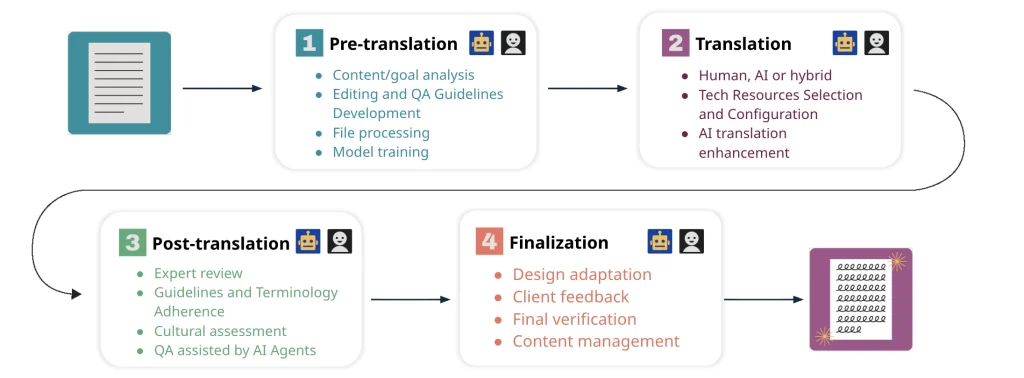
Here’s what it looks like in practice:
Pre-Translation
We start by collaborating with clients to understand their goals, target audiences, and desired tone. We review marketing briefs, style guides, glossaries, and past translations – or create them if they don’t exist. We also prepare files to ensure compatibility with translation workflows.
Translation
Next, we determine the right approach: human, AI, or hybrid. For highly creative or high-stakes projects, we may skip AI altogether. For large-volume or technical content, we may train a specialized AI model and pair it with human translators. Our tech team adjusts backend settings and sometimes deploys multiple AI models to refine output.
Post-Translation
Professional translators review the output, correcting errors, refining style, and ensuring cultural relevance. We may use AI tools again here, this time for quality checks – prompting models to identify inconsistencies or generate error reports.
Finalization
Finally, we reconvert and format files to match the original layout, adjusting for language-specific needs like text expansion. If client review is part of the process, we incorporate feedback and store translations for future consistency.
At every stage, the foundation is the same: human judgment.
Sometimes Boxed Wine is Fine
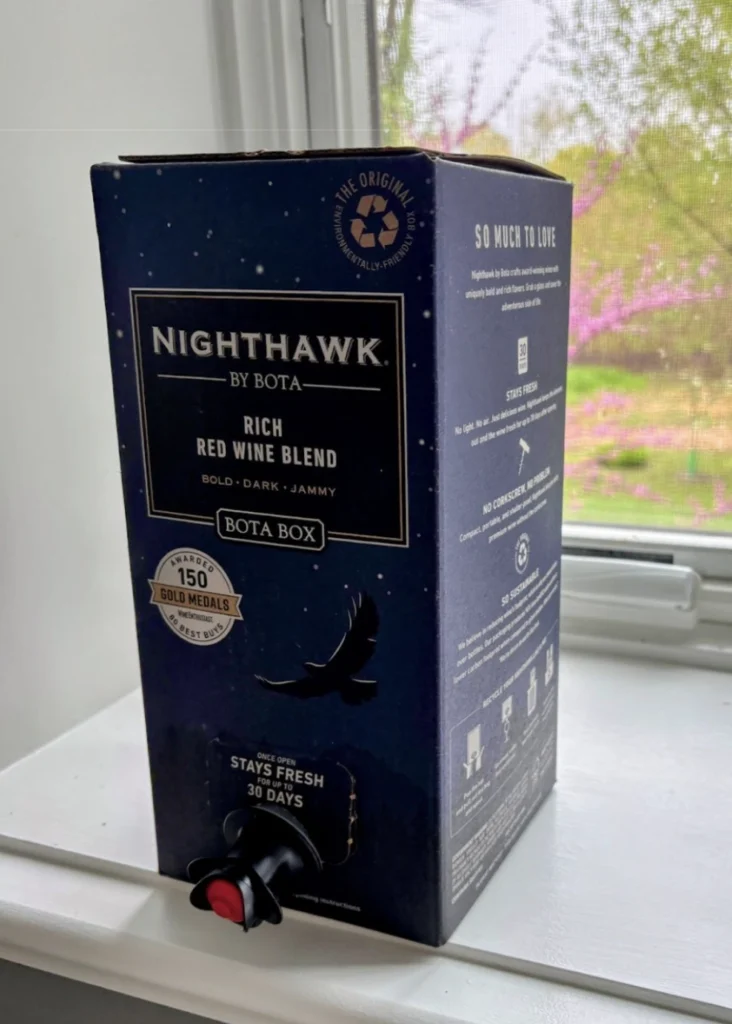
Sometimes moldy strawberries are salvageable. Sometimes good enough is good enough. And that’s why I have a box of red wine in my kitchen. It’s not fancy, but it’s fine. It’s open. It does the job on a weeknight when I want a quick glass of wine as I snack on some leftovers for dinner.
But if I’m at a nice restaurant celebrating something special? That’s where a sommelier makes sense: someone who asks about the meal, the mood, the occasion – who brings expertise and context I don’t have and who can recommend something beyond what I can envision.
Translation works the same way. Sometimes boxed wine – or AI – is fine. But when nuance, identity, and authenticity matter, you need a partner. You need expertise. You need more than a machine.
Don’t Let Language Be an Afterthought
As professionals, we know how critical trust and authenticity are. Good translation doesn’t just transmit meaning – it builds relationships. It invites honesty. It opens space for deeper insights. And despite the convenience of platforms with automated translation (also known as “translation as a feature” or “TaaF”), when convenience replaces accuracy, you risk losing the very trust you hope to create.
Sometimes “good enough” is good enough, but when it’s not, it’s important to have a partner on your side who knows how to manage complexity, balance people and technology, and see the mold – even when you can’t.
Interested in learning more about how we can help ensure nuance and trust?
FAQ
What is hybrid human-in-the-loop translation and why does it matter?
Hybrid human-in-the-loop translation combines the speed and efficiency of AI translation tools with the expertise of professional linguists. While AI can quickly process large volumes of text, human translators refine meaning, add cultural nuance, and ensure inclusivity. This approach prevents mistranslations that can damage brand reputation, distort research findings, or introduce bias.
What are the main limitations of AI translation alone?
AI translation struggles with cultural context, gender inclusivity, emotional nuance, and consistency. For example, AI often flattens idioms, defaults to masculine forms in gendered languages, and misses subtle distinctions in tone that matter in surveys, contracts, or marketing campaigns. Without human oversight, these blind spots can undermine clarity, accuracy, and trust.
When should I use AI translation versus human translation?
AI translation can be “good enough” for informal or internal purposes – like quickly understanding a foreign-language article or processing bulk content where minor errors don’t matter. However, for high-stakes projects, such as outbound surveys, legal contracts, global marketing, and medical communications, professional human translators (often in combination with AI) are essential to ensure accuracy, cultural sensitivity, and inclusivity.