


Qualitative research transcription in 75+ languages
Qualitative research transcription depends on more than accurate typing. When you’re working across diverse communities, participants’ language, dialect, and cultural context shape what gets said and how it should be understood on the page.
Multilingual Connections provides qualitative research transcription in 75+ languages for focus groups, in-depth interviews, ethnography, and the full range of qualitative methods, with human linguists who capture nuance an AI tool would flatten. Transcripts are built to be coded and analyzed, not just read.
Qualitative research methods we transcribe
Qualitative research spans a range of methods, and each one shows up in a recording differently. How people talk in a group setting isn’t how they talk one-on-one, and a clinical interview carries different stakes than a marketing focus group. Here’s how we support the methods researchers actually use, grouped by who’s running the study.

Market and consumer research
For market research teams, we transcribe:
- Focus groups and in-depth interviews, with speaker labeling that holds up when a group of six is talking over each other
- Phone surveys
- Intercept interviews and surveys
- Mobile journeying and diaries
- Role play and simulation sessions

Academic and social science research
For academic research projects, often across multiple site visits and multiple languages within the same study, we transcribe:
- Ethnography and participant observation
- Narrative analysis
- Oral histories
This work supports dissertation research, conference recordings, and cross-cultural fieldwork across academia.

Healthcare and public health studies
For public health and clinical teams, we transcribe:
- Patient and provider interviews
- Clinical study focus groups
- Community health research
Accuracy in what a participant actually said, not a cleaned-up paraphrase, can affect how findings get used across all these sectors.
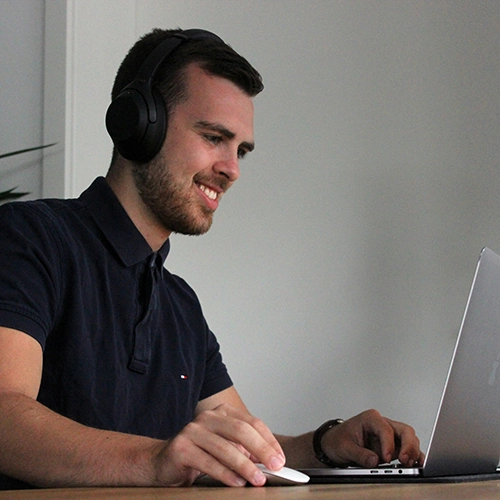
Transcripts built for analysis, not just a record
A transcript that reads cleanly isn’t the same as one that holds up under coding. In qualitative research, the exact word a participant uses is data: the difference between someone describing themselves as “afraid” versus “anxious” can shift how a theme gets coded and what the finding actually says. Our transcriptionists preserve that precision rather than smoothing it into whatever reads best.
Timestamps let you go back to the original recording and cite an exact moment, not just a page number, which matters when you need to verify a quote or pull a clip for a stakeholder presentation. And in group settings, moderator and respondent labeling stays clear and consistent even when a focus group has six people talking over, interrupting, or finishing each other’s sentences, so you can actually tell who said what when you sit down to code the data.
Multilingual and cross-cultural qualitative research
International and comparative research often means recordings in one language and analysis happening in another, sometimes across a dozen countries in the same study. We deliver transcripts in the original language, in a second language, or in both side by side, depending on how your research team works, without flattening what a participant actually said into a literal, word-for-word rendering that misses the cultural context behind it.
This is where our 75+ languages and a linguist’s understanding of dialect, register, and cultural nuance matter more than raw language coverage. For the full range of multilingual transcription services, including monolingual, interpretive, and double-column formats, see our transcription hub.

Why choose Multilingual Connections for qualitative research
- Cross-cultural and multilingual research is a specialty here, not a checkbox: every transcript is handled by a human linguist, not run through an AI tool alone.
- Founded by a linguistic anthropologist and operating since 2005, our background is suited to ethnography and cross-cultural nuance specifically, not just language conversion.
- Market-research proven:: the Threadline team relied on us for exactly this kind of work. Read the Threadline case study.
- Confidential handling of participant data throughout, since qualitative recordings often carry information researchers have committed to protecting under IRB or ethics board terms.
- Part of a full transcription and qualitative research support offering, so translation, interpretation, and research support are available under the same relationship.
Looking for qualitative research transcriptions?
No matter the language, Multilingual Connections provides accurate, affordable and timely transcription for qualitative research. Since 2005, we’ve supported businesses, marketing and market research firms, public health organizations, and academia to transcribe foreign language research and ensure effective data analysis, including:
- Focus Groups
- Ethnography
- In-depth Interviews
- Participant Observation
- Mobile Journeying & Diaries
- Phone Surveys
- Intercept Interviews & Surveys
- Narrative Analysis
- Role Play & Simulation

Flexible transcription options

Monolingual
Language A → Language A
Use monolingual transcription if you have an audio or video file and need a transcript in the same language as the one spoken in the file.
Interpretive
Language A → Language B
Use interpretive transcription if you have an audio or video file in one language and need a transcript in another language.
Double column
Language A → Language A & B
Use double-column transcription if have an audio or video file in one language and need a transcript in the same and in another language.
When nuance and culture matter
Since qualitative research focuses on individuals, groups, and cultures, qualitative data is more difficult to record and copy compared with quantitative data. Here, nuance and culture matter. If you’re a researcher, you know how time-consuming each step of the qualitative research transcription process can be. Our transcription services can help you streamline your process, save time, and preserve the quality and usability of the original recordings.

Request a quote
It all starts with a first connection. Tell us how our international network of linguists and dedicated project managers can help!
Frequently Asked Questions
How do you keep focus group and interview recordings confidential?
Recordings and transcripts are handled under confidentiality agreements, with every linguist working on your project bound by NDA. Client audio and transcripts are not used to train AI models. This is the kind of detail researchers often need to name specifically in an IRB consent form before recruitment even starts.
Are transcripts compatible with NVivo, ATLAS.ti, and MAXQDA?
Yes. Transcripts are formatted to import cleanly into common qualitative analysis software, including NVivo, ATLAS.ti, and MAXQDA, with consistent speaker IDs and timestamps built in for coding. If your project needs a specific format or field structure, let us know when you send your files.
Can you transcribe remote sessions recorded on platforms like Zoom or Teams?
We know that fieldwork, ethnography, and intercept interviews rarely happen in soundproof rooms. Our human linguists are experienced in parsing difficult audio, overlapping dialogue, and background noise. If a section is truly inaudible, we clearly timestamp and flag it in the text so you know exactly where the gap is, rather than guessing or inserting inaccurate words.
Can you deliver interviews in batches as I complete fieldwork?
Yes. Transcripts can be delivered on a rolling basis as sessions are completed, so you can start coding before fieldwork wraps rather than waiting for the last interview. For large studies or less common languages, it’s worth booking early so capacity is lined up as recordings come in.
What if my recordings have background noise or poor audio quality?
Research transcription preserves exact wording, non-verbal cues, and clear speaker roles, the details coding depends on. A general typing service tends to clean up and approximate, smoothing out the very details that make a transcript usable for thematic analysis.
Do you transcribe non-English and mixed-language focus groups?
Yes. Human linguists handle non-English sessions and code-switching within a single conversation, capturing each language a participant uses rather than dropping the parts an English-only tool can’t follow. This matters most in exactly the sessions where it counts: multilingual communities where participants naturally move between languages.
How do we send you our audio files?
We offer flexible options to fit your workflow and data security requirements. You can easily share files with us via email or a secure link. However, if your research involves highly sensitive participant data or requires strict IRB compliance, we also provide a secure, encrypted client portal to ensure your file transfers are fully protected.