AI translation has transformed how global marketing content is created. With just a few clicks, teams can launch campaigns in multiple languages quickly, affordably, and at scale. For organizations managing tight timelines and high content volumes, it can be an incredibly appealing solution.
But what gets lost in that efficiency?
For all its advantages, AI translation often overlooks the very elements that make marketing effective: emotional resonance, cultural nuance, and contextual accuracy. What sounds right in one language might fall flat – or worse, backfire – in another. And for high-stakes campaigns where brand perception is on the line, “close enough” just isn’t good enough.
That’s why, even in a tech-driven era, human translators still play a vital role in shaping messages that don’t just cross borders – they connect.
Translation Isn’t Just a Technical Task – it’s an Emotional One
Think about the campaigns that move you. They don’t just convey information; they make you feel something. And feeling is where the machines still fall short.
Depending on the language, machine translation can often (though not always) get the grammar right. It can even mimic tone or preserve slogans. But it doesn’t understand the deeper emotional resonance behind a phrase – the context, the history, or the unspoken cultural layers that give a message its power.
For multilingual marketing translation, that understanding isn’t optional. It’s essential.
The Power of Cultural Empathy
Emotion doesn’t translate word-for-word. Humor, nostalgia, pride, even urgency – these are culturally constructed experiences. What feels warm and inviting in one language may come across as pushy or awkward in another. Human communication is complex, and even more so when crossing borders.
This is where cultural empathy becomes essential.
Professional translators with cultural fluency don’t just carry over the words of a campaign. They carry over the meaning. They consider the values, beliefs, and shared histories of the target audience. A tagline celebrating freedom or independence, for example, may resonate strongly in the US while stirring sensitive political associations elsewhere. A phrase like “homegrown” might carry a sense of authenticity in one market and feel provincial or even exclusionary in another. Even color symbolism plays a role. White, for instance, represents purity in many cultures but mourning in others – a difference that can completely shift a campaign’s emotional tone. Consider also the subtle variations in expressions of support. “We’ve got your back” and “We walk beside you” both communicate care, but they conjure very different images. These are the kinds of nuances that professional linguists navigate daily as they work to ensure your message isn’t just translated accurately, but conveyed meaningfully.
They also understand what not to say. References to pop culture, idioms, sports, or political themes might hit the right note domestically but require a complete rethink abroad. That kind of judgment call isn’t something AI is ready for. It’s a human skill, built from years of living in, working with, and understanding a culture.
Ultimately, cultural empathy is what allows brands to move from being simply understood to being appreciated and even loved in the markets they enter.
“Good Enough” Isn’t Always Good Enough
We often hear from clients who are using AI to manage their growing volume of multilingual content. Sometimes, they tell us, the results are “good enough.”
But “good enough” is a dangerous metric when trust is on the line.
Emotionally flat or culturally off-base translations can erode brand perception quickly. Even subtle missteps, whether a clunky phrase, a tone that feels too casual or too formal, or a joke that doesn’t land, can create a sense of distance or inauthenticity. These may be small issues, but they matter. Especially when your audience is deciding whether or not to engage with your brand.
Blending Speed with Sensitivity
Of course it’s not a binary choice between humans and technology. The smartest strategies blend the two.
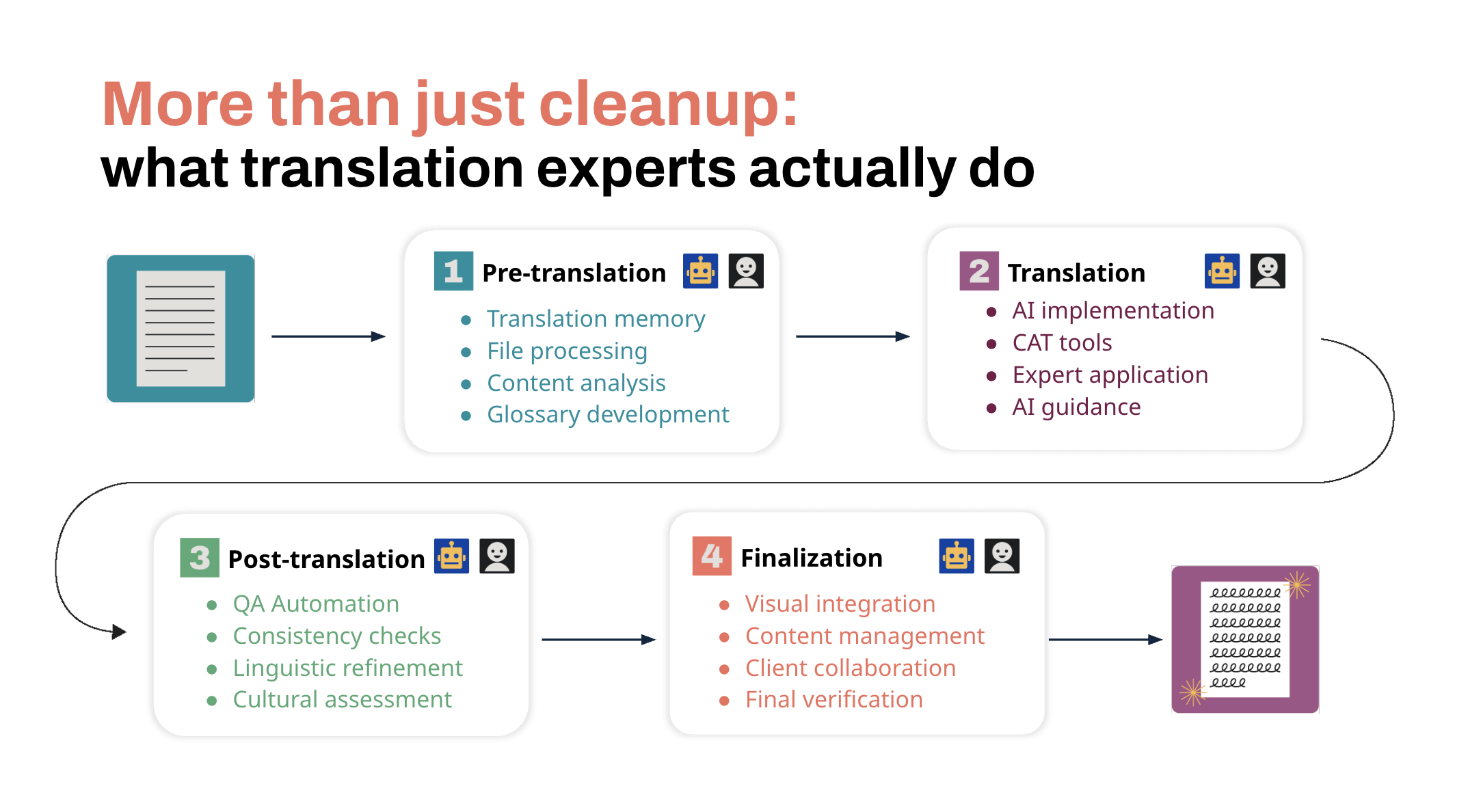
At Multilingual Connections, we build thoughtful workflows based on our clients’ goals, content type, and audience. What tools make sense for this language pair? Where should automation stop and human insight begin? How do we preserve brand voice across multiple regions? Our workflows integrate human expertise at every stage of the process and may include:
- File analysis and prep to ensure compatibility
- Choosing an AI model to ensure the best first draft for the project
- Prompt engineering to ensure the most accurate output
- Translation memory (TM) alignment to support consistency across projects
- Glossary creation and terminology management aligned with brand tone
- Incorporation of style guides tailored to specific markets or campaign types
- Translation or translation review by specialized marketing linguists
- QA protocols and cultural review to ensure accuracy and emotional impact
It’s not just “cleaning up” after AI, and it’s more than just a human-in-the-loop model. Rather, it’s a human strategy built around your business needs, with technology as an accelerator, not a substitute.
Marketing with Meaning
In an era of automation, empathy is your competitive edge. It’s what allows you to move beyond mere translation and into localization and transcreation – the art of adapting content with cultural and emotional intelligence. It’s what helps your global message land with the same impact, intention, and authenticity as your original.
And that kind of connection? It doesn’t happen by accident.
So as you think about your next multilingual campaign, ask yourself: Are you just being understood? Or are you being felt?
At Multilingual Connections, we help brands around the world make the leap from algorithm to empathy and create meaningful connections with their audience in 75 languages. Interested in creating those kinds of connections? Reach out to chat with us!