


Remote simultaneous interpretation services
If your event is virtual or hybrid and you need real-time interpretation for a multilingual audience, remote simultaneous interpretation is almost certainly the most practical and cost-effective way to do it. No booth. No wireless receivers to distribute. No equipment vendor to coordinate. Just professional interpreters working remotely, and your attendees listening in their own language on their own device.
Multilingual Connections provides remote simultaneous interpretation services in 75+ languages for conferences, webinars, virtual meetings, and hybrid events. We handle the language and the logistics as one service, so there’s no platform to evaluate, no software to integrate, and no separate vendor to manage alongside us. You contact us, we deliver the interpretation.
What is remote simultaneous interpretation?
Remote simultaneous interpretation (RSI) is real-time spoken language interpretation delivered for events without a physical interpretation booth or onsite equipment. Interpreters work from a remote location via a cloud-based audio feed rather than from a booth at the venue, and attendees select their preferred language and listen through their own smartphone, tablet, or computer.
The “simultaneous” part means interpretation happens in real time alongside the speaker, not in pauses between statements the way consecutive interpretation works. For conferences, large presentations, and multilingual webinars, simultaneous interpretation is what allows a multilingual audience to follow along without the event grinding to a halt every few sentences. RSI delivers that in a format built for virtual and hybrid events.


How remote simultaneous interpretation works
The process is straightforward on the attendee side, which is the point.
- The event audio is captured and sent in real time to a professional interpreter working remotely via a secure cloud connection.
- The interpreter listens and interprets simultaneously, delivering the content in the target language as the speaker continues.
- Attendees select their preferred language channel on their own device and listen to the interpretation through that channel.
- No equipment is required on the venue or attendee side. There are no wireless receivers to rent, distribute, or collect.
For clients who prefer to have traditional headsets and wireless receivers available alongside remote interpreters, a hybrid RSI option is available. This gives organizations running partially in-person events the flexibility to support audience members who’d rather use physical equipment, without committing to a fully onsite simultaneous setup.
RSI vs. onsite simultaneous interpretation
Both RSI and onsite simultaneous interpretation deliver real-time interpretation for audiences listening in different languages. The differences are logistical and financial.
For events that are fully virtual, RSI is usually the straightforward choice. For hybrid events, we can help you decide whether a full onsite setup, RSI, or a hybrid of both fits your audience and venue best.
OSI
Onsite simultaneous interpretation requires booth setup at the venue, wireless receiver and headset equipment distributed to attendees, and onsite technical support to manage the equipment throughout the event. Multilingual Connections provides all of this when onsite simultaneous interpretation is the right choice. But for virtual and hybrid events, it’s both unnecessary and impractical.
RSI
RSI removes the equipment requirement entirely. Interpreters connect remotely, attendees use their own devices, and the event runs without an onsite equipment setup. The cost difference is real and specific: RSI typically runs 30 to 40 percent less than traditional onsite simultaneous interpretation, since booth rental, equipment costs, and onsite technician logistics are removed from the equation.
Who uses remote simultaneous interpretation
RSI is used wherever a multilingual audience needs to follow a live event in real time and onsite logistics either aren’t practical or aren’t necessary.
- Conference organizers: for international virtual or hybrid conferences without the overhead of onsite setups.
- Market research teams: for international virtual focus groups and multilingual discussion panels.
- HR and training teams: for delivering multilingual training and onboarding to distributed workforces.
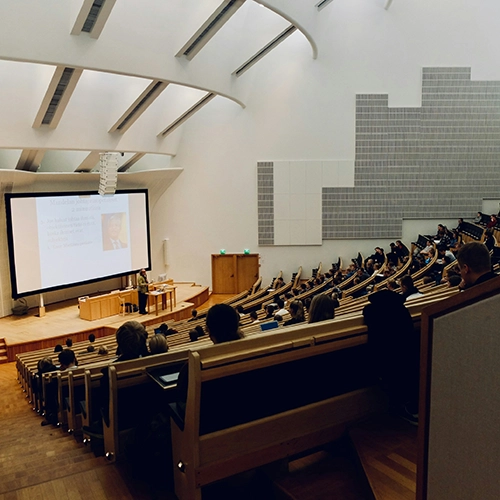
- Academic institutions: for making multilingual lectures and symposiums accessible.
- Webinar teams: for adding language support without overhauling existing platforms.
Why choose Multilingual Connections
- One point of contact for language and logistics: we handle interpreter selection, briefing, and delivery end to end, with no platform to evaluate or manage separately
- Human-linguist-led interpretation throughout: our RSI service uses professional human interpreters, not automated speech translation, so accuracy and cultural nuance are handled the way they would be for any professional interpretation engagement
- No equipment required, with a hybrid headset and receiver option available for clients who want physical equipment alongside remote interpreters
- 30 to 40 percent lower cost than traditional onsite simultaneous interpretation, a real and specific saving that removes booth, equipment, and onsite technician costs from your event budget
- Multilingual Connections was founded by a linguistic anthropologist, and that foundation shapes how we select and brief interpreters for every event context, from a technical conference to a multilingual research session
- Part of a full interpretation services offering: onsite, telephonic, and RSI available under one relationship, so your interpretation needs don’t require multiple vendors as they evolve
Request a quote
It all starts with a first connection. Tell us how our international network of linguists and dedicated project managers can help!
Frequently Asked Questions
How many language channels can a single RSI event support at once?
There’s no fixed cap tied to the technology itself, it scales with how many language pairs your audience actually needs. Larger international conferences sometimes run a dozen or more channels simultaneously. The main planning factor is sourcing enough qualified interpreters for each pair, worth flagging early for less common languages.
Do attendees need to download an app, or is it browser-based?
Browser-based, generally, so attendees join through a link rather than installing anything beforehand. That’s part of why RSI works well for external or public audiences, since there’s no download friction standing between someone and the language channel they need.
Do interpreters receive materials like slides or a glossary before the event?
Yes, and this preparation makes a significant difference in quality. Just as they would for an onsite assignment, our interpreters review your slides, agendas, and organization-specific terminology ahead of time. The more context provided in advance, the smoother and more confident the live interpretation will be.
Is there a tech check before the live event, and who handles it?
Yes, we run a connection and audio check with interpreters ahead of time, and can coordinate a joint check with your AV team or platform if needed. It’s a short step that catches issues while there’s still time to fix them.
What happens if an interpreter's connection drops mid-event?
This is a common concern with remote interpretation, and it’s planned for. For larger or higher-stakes events, interpreters can be paired with backup coverage, similar to how onsite simultaneous interpreters rotate. Worth raising during scoping if connectivity risk matters for your event.
Is RSI as accurate as onsite interpretation?
Yes, accuracy comes down to the interpreter, not the delivery format. The same vetting, language-pair matching, and subject preparation apply whether someone is working from a booth or remotely, so quality doesn’t drop just because the setup is virtual.