


Legal and law enforcement transcription in 75+ languages
Legal transcription services carry a different weight than general transcription: a deposition or a wiretap recording often becomes part of the official record, and what’s on the page has to match exactly what was actually said, in whatever language it was said in.
Multilingual Connections provides legal and law enforcement transcription in 75+ languages, from depositions and court hearings to foreign-language wiretaps and jail calls, handled by linguists trained in legal terminology and bound by confidentiality throughout every project. Whether the material is headed into a courtroom or an active investigation, the standard doesn’t change.
Looking for law enforcement & legal transcriptions?
No matter what the language, Multilingual Connections provides accurate, affordable and timely transcription services for sheriff’s departments, police departments, district attorneys, departments of corrections, law firms, attorneys, paralegals and legal assistants. Examples of the types of legal content we transcribe:
- Public Hearings
- Wiretaps
- Jail Phone Calls
- Police Interviews
- Administrative Hearings
- Meeting Minutes
- Group Discussions
- Conferences
When working with multilingual and multicultural populations, it is important for the legal and law enforcement community to be sensitive to language needs and preferences. Our law enforcement and legal transcriptionists are highly experienced in the field, trained in legal and law enforcement terminology and procedures, and understand cultural nuances.
What we transcribe for legal and law enforcement

Law enforcement and investigations
For law enforcement and investigations teams, we transcribe:
- Wiretaps and covert recordings, where the exact words used in another language often become central to the case
- Jail phone calls, including recordings with background noise and multiple speakers talking over each other
- Police and suspect interviews, with clear speaker labeling for the interview record
- Body-cam and dashcam recordings, capturing dialogue in the field rather than a controlled setting
- 911 calls, transcribed with attention to what’s said in the first critical moments
- Administrative hearings, including licensing and regulatory proceedings

Legal proceedings and law firms
For attorneys and legal teams, we transcribe:
- Depositions, prepared to the verbatim standard a legal record requires
- Court and administrative hearings, at both the state and federal level
- Arbitration and mediation sessions, where a clear record supports the outcome
- Meeting minutes for firms managing multilingual staff or clients
- Attorney-client recordings, handled with the same confidentiality as privileged communication
Not sure which format fits your case? Our project managers can advise on style and formatting before work begins, so you’re not guessing at what a court or department actually needs.
Foreign-language wiretaps, jail calls, and interviews
This is where an English-only transcription vendor stops being useful. A wiretap, jail call, or interview conducted in another language still needs to become part of the record, and that takes a human linguist who understands not just the language but the slang, dialect, and cultural context that a literal, word-for-word rendering misses. A Spanish-language wiretap, a Haitian Creole jail call, a Mandarin witness interview, the vocabulary and stakes shift by case, but the need for a linguist who understands both language and context stays the same.
We deliver foreign-language recordings as a clean English transcript, or as a side-by-side original-language and English record when investigators or attorneys need to verify the exact original wording against the translation. That second format matters more than it sounds: when a case turns on exactly what was said, and in what language, a transcript that shows both versions side by side holds up to scrutiny in a way a translation alone doesn’t.
Our 75+ languages and human linguists are part of the same multilingual transcription services available across every case type on this page.

Accuracy and confidentiality for sensitive cases
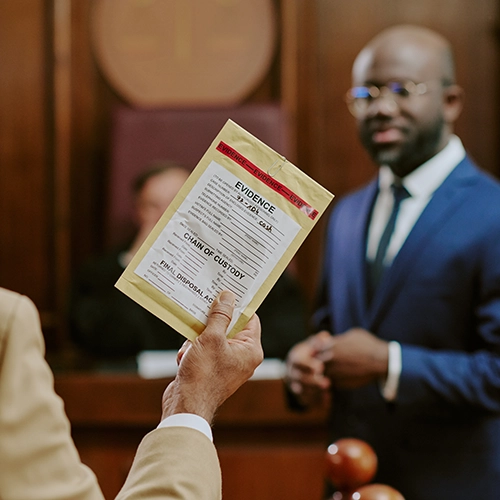
Evidentiary and investigative material has to hold up to scrutiny, so precision isn’t optional. Transcripts are prepared to a verbatim standard, with speaker labeling that stays clear even in a multi-speaker interview or a chaotic jail call, and anything inaudible or crosstalk-heavy is marked as such rather than filled in with a best guess.
Timestamps let you reference an exact moment in the recording rather than a page number, which matters when a transcript is being cited back against the original audio. Every linguist working on a case is bound by NDA, and case files are handled securely from the moment they’re received through delivery, whether the material is a single interview or an ongoing investigation with a large volume of recordings. Formatting stays consistent across every recording in a case, so multiple transcripts from the same investigation read as one coherent record rather than a stack of inconsistent files.
Legal transcription options
Different projects have different requirements. Which option best describes your needs?

Monolingual
Language A → Language A
Use monolingual transcription if you have an audio or video file and need a transcript in the same language as the one spoken in the file.
Interpretive
Language A → Language B
Use interpretive transcription if you have an audio or video file in one language and need a transcript in another language.
Double column
Language A → Language A & B
Use double-column transcription if have an audio or video file in one language and need a transcript in the same and in another language.
Just let us know which option is best for you, upload your files and share a few additional details: audio duration and quality, number of speakers, formatting requirements, turnaround and anything else you think will be helpful.
If you’re not sure what you need, our team of experienced project managers is ready to partner with you to find the best option for your goals and audience. We have extensive experience in the law enforcement field, and can provide informed recommendations on style and formatting to fit your needs.
Why choose Multilingual Connections for legal transcription
- Foreign-language legal and law enforcement transcription as a specialty, not a workaround bolted onto an English-only process built for a different kind of content.
- Verbatim accuracy and confidentiality on every case, from a single interview to an ongoing investigation.
- Human linguists trained in legal terminology, not just general transcription.
- Operating since 2005 and founded by a linguistic anthropologist, our background is suited to language work where dialect and cultural context carry real weight, not just literal word-for-word conversion.
- Part of a full language offering: transcription services alongside court and deposition interpreting and document translation, available under one relationship.
Request a quote
It all starts with a first connection. Tell us how our international network of linguists and dedicated project managers can help!
Frequently Asked Questions
Can transcripts be certified or notarized for court use?
Transcripts are prepared to a strict verbatim standard, with clear speaker labeling and notation of anything inaudible. If your case needs a certified or notarized transcript, share your court’s specific requirement so we can confirm what’s available for that jurisdiction, since admissibility standards vary by jurisdiction.
Do you meet CJIS or chain-of-custody requirements for criminal justice agencies?
Every linguist working on law enforcement material is bound by NDA, and case files are handled with strict confidentiality throughout a project. For a specific framework like CJIS, reach out directly to confirm current status and how it applies to your agency’s requirements, rather than assuming.
What if our investigators aren’t sure exactly which language or dialect is being spoken on a recording?
This is a common situation with wiretaps and covert recordings. If your team isn’t sure of the exact language or regional dialect being spoken, we can review a short sample of the audio to help identify it. This ensures we assign a linguist with the right regional and cultural expertise to your case from day one.
Can you match our department's or court's formatting and reporting template?
Yes. Transcripts can follow your required template, including speaker labels, timestamp intervals, and case-reference formatting, delivered in the file type your workflow uses. Send your format requirements along with the recording so the output matches what you need from the start.
How fast can you deliver transcripts for a case or filing deadline?
Turnaround depends on audio length, quality, and language, with rush options available for deadline-driven work. If you’re working against a filing or court deadline, share that date upfront so the timeline gets built around it rather than a standard delivery window, especially for longer recordings or less common languages.
Do you also translate written legal documents?
Transcription converts a recording into text. For translating written legal documents, contracts, filings, or evidence exhibits, that’s handled by our translation service, often on the same case alongside the transcription work, so both pieces stay consistent in terminology and handling.