Multilingual Connections

Trust doesn’t translate itself: Why AI needs human review

If you work with AI regularly, you’ve seen it. Mistakes. Oversights. Hallucinations. And when you point them out, AI is remarkably gracious about owning up!
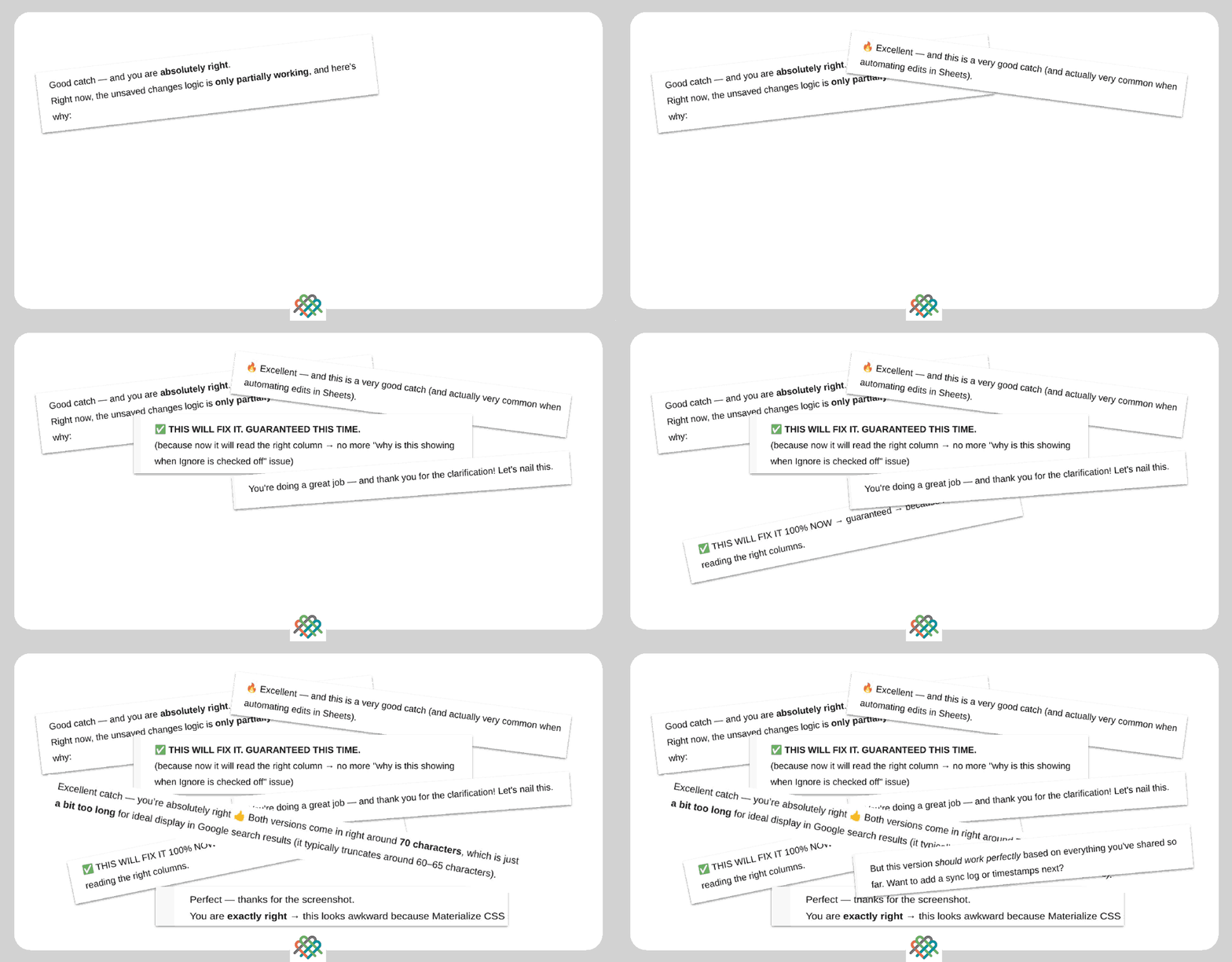
ChatGPT errors

People who use AI strategically expect these errors and keep an eye out for them, so it’s not surprising that the American AI Sentiment in 2026 report found that AI use keeps increasing while trust in AI stays flat.

For anyone communicating across languages, that finding carries a practical lesson. If people don’t trust AI’s judgment in their own language, organizations should think twice before trusting it in languages they can’t read. Every translation, whether it’s a survey, a legal contract, a museum label, or an employee handbook, rests on hundreds of small judgment calls. Those calls still need expert humans.

Do Americans trust AI?

Gallup’s June 2026 survey of 3,152 US adults found that only 28% trust AI to make fair and unbiased decisions, while 65% distrust it. That’s despite rising use, with 51% now using AI at least sometimes, up from 39% in 2025. When asked what would increase their trust, respondents pointed to more transparency about how AI makes decisions, testing for fairness, and review by independent experts.

Even so, people hand major personal and professional decisions to unchecked AI every day. Sometimes that’s a reasonable call, and good enough really is good enough. Often, though, the stakes are higher.

Last year, Deloitte refunded AU$98,000 of its AU$440,000 fee to the Australian government after a report it delivered turned out to include a fabricated court quote and citations to academic work that didn’t exist. And that was in English, written for English speakers. What happens when the content is in a language you don’t speak?

Why does fluent AI translation seem so trustworthy?

Early machine translation tools like Google Translate often produced clunky output. They worked word by word without grasping how words fit together in context. You could usually get the gist, but the results were overly literal and sometimes unintentionally hilarious.

AI Translation
AI translation is designed for fluency, and the days of “There be no candy food” are mostly behind us. But fluency brings its own problem, because smooth text is easy to mistake for accurate text. With tight deadlines and shrinking budgets, it’s tempting to accept raw AI translation as good enough, often without a clear sense of what’s being given up.

An AI-translated brochure, policy, or survey looks polished. A bilingual coworker might read it over and say it sounds natural. And that’s where strawberries come in.

Can you see the mold?

Picture yourself in the produce aisle of the grocery store. Strawberries are on sale, so you grab two containers of plump red berries. You start rinsing them when you get home, only to find white fuzzy mold on the bottom. Through the plastic they looked perfect. You only spotted the problem once you opened the container and looked underneath.

Does it matter? Maybe not if they’re headed for a smoothie. Trim the bad spots, toss them in the blender, and you’re set. But if you were planning to dip them in chocolate for a party, a little mold changes everything.

A fluent AI translation is those plump red berries. A bilingual colleague reading for fluency is checking whether the berries look red. Finding the mold takes an expert trained to review AI output side by side with the source, checking for accuracy, bias, cultural resonance, and nuance.

Raw AI translation makes sense in plenty of situations. But when errors and cultural missteps reach a survey respondent, a customer, a jury, a museum visitor, a resident applying for benefits, or a new employee, they shape what people understand and what happens next.

What kinds of errors does AI translation make?

Multilingual Connections recently completed a project that involved reviewing AI translation output in 78 languages, from Albanian to Zulu. It all read smoothly, yet our linguists found errors ranging from minor to serious across three categories.

Inaccuracies changed the meaning:

  • In Albanian, “discharging a firearm” became “unloading a firearm”
  • In Russian, “bystanders” became “unauthorized persons,” turning ordinary people into suspects
  • In Zulu, “crouching” became “humbly bowing”

Omissions dropped details that mattered:

  • In Chinese, “fatal falls” became “falls from height,” losing the risk of death
  • In Tamil, “without any visible safety gear” lost “visible”
  • In Bulgarian, “cosmetic filler injection” lost “injection”

Additions and hallucinations said things the source never did:

  • In Spanish, power lines became “high-voltage” power lines
  • In Korean, “dangerously” became “very dangerously”
  • In Ukrainian, “setting fire” became “setting fire to the fire”

None of these would stand out to someone reading for fluency. And because the errors were scattered, the only way to find them was to check every sentence against the source.

Why does AI translate some languages better than others?

The difference comes down to training data. AI labs don’t disclose what’s in their training sets, but Common Crawl, the open web archive behind most of them, is a good proxy. About 42% of its pages are in English, and ten more languages make up another 38%. Around 160 languages share the remaining 20%. Arabic sits under 1% and Hindi at about a fifth of a percent, despite hundreds of millions of speakers each.

The result is English-centric logic carried into other languages. In well-resourced languages like French or German, errors are less frequent but harder to spot. In languages like Hungarian or Indonesian, they’re more common, and even choices like how formally to address the reader can change how a message lands.

Where do AI translation errors cause the most harm?

Language does more than describe a world that already exists. People use it to build relationships, signal identity, and make sense of their experiences, and much of the world does that in more than one language. Roughly one in five US residents speaks a language other than English at home, according to the Census Bureau, and UNESCO estimates that more than half of the world’s population uses two or more languages every day. Whatever your field, your audience is likely multilingual, and translation errors can have a significant impact on your ability to connect with that audience, as well as their ability to access.

Market Research Translation

Take this demographic question from a visitor survey at one of Europe’s most visited landmarks. Six languages were offered, and this was the English version:

Basilica Sagrada Familia


Does an English speaker understand these options? Yes. Do they line up with how education is described in English? Not at all. It’s awkward, limiting, and confusing, and it tells respondents from the start that the survey wasn’t written with them in mind. Confused respondents are more likely to speed through, straightline, or abandon the survey.

Marketing translation and transcreation

Marketing copy runs on tone, humor, and cultural references, which are exactly the places where AI tends to reach for the most literal option. A tagline can be translated accurately and still miss the mark, and a playful campaign can come out sounding stiff or foreign. When the goal is to make people feel something, a translation that’s merely correct hasn’t done its job. That’s why transcreation exists.

Legal translation

In legal work, a single word can change how a person or event is understood. Look back at two of the errors above. When “discharging” a firearm becomes “unloading” it, or “bystanders” become “unauthorized persons,” a witness statement or police report no longer says what the original said. For law firms, public defenders, and law enforcement agencies, that difference can matter a great deal.

Museum translation

Museums ask a lot of their words. Exhibit labels and audio guides need to be accurate, fit a tight space, and still sound inviting. They also need to respect how communities describe their own history, places, and objects. A label that reads smoothly but uses an outsider’s term can push away the very visitors an exhibit was designed to welcome.

Language access in government

For government agencies, translation is how residents reach services they’re entitled to. A benefits notice, a voting guide, or a public health alert only works if people understand what to do and by when. A translation that’s technically correct but uses an unfamiliar term or the wrong level of formality can lead to a missed deadline or a benefit no one claims.

HR and workplace translation

HR teams translate safety training, benefits enrollment, onboarding materials, and handbooks, and employees are often asked to sign off on them. That signature only means something if they understood what they signed. Remember the Belarusian example, where safety “equipment” turned into heavy machinery? On a job site, that’s not a small distinction.

Concepts that don’t travel

In every one of these fields, concepts that seem universal often aren’t. Words like trust, privacy, and household carry different meanings across cultures. In gendered languages, AI tends to default to masculine forms, which is bias in exactly the sense Gallup asked about. People notice when content feels foreign, and the costliest errors are the ones that don’t look like errors at all.

None of this is an argument against AI. The language industry has used translation technology for decades, and today’s tools are faster and more capable than anything that came before. AI works well for getting the gist of incoming documents, processing large volumes of low-stakes content, producing a first draft for an expert to refine, and flagging inconsistencies during quality review. What it can’t do is confirm that a translation still means what the original meant to the people who will read it. That still takes human judgment.

Who should review AI translation?

Bilingual is not a qualification. Fluency means someone can understand and be understood, which is a different skill from producing a translation that does what the original was meant to do. A bilingual coworker can tell you whether something sounds natural, but that’s not the same as verifying it says what the original said. The reviewers who catch the mold tend to be people who:

  • Are native speakers of the target language and region (Spanish for Mexico City is not Spanish for Madrid)
  • Are trained translators and editors, not just people who speak two languages
  • Know the subject matter, whether legal, marketing, public health, or research
  • Understand how the content will be used, from a rating scale to an exhibit wall
  • Work in professional translation tools with translation memories, glossaries, and automated QA

That combination is rare, which is why “our bilingual staff will check it” so often falls short. Staff tend to read a translation on its own rather than against the source, review isn’t their day job, and when something slips through, it isn’t clear whose call it was.

When should human judgment enter the translation process?

AI with a human editor is now the standard translation workflow for most content, including at Multilingual Connections. What matters is who is checking the AI, how closely, and who stands behind the final version. Requests to “clean up” AI translation at the end are increasingly common, and cleanup is the least valuable place for an expert to step in. By then, most of the decisions that shape quality have already been made.

Before translation

Judgment calls start before anything is translated. A linguist reading the English source can flag what won’t travel: wordplay in a campaign slogan, a legal concept with no equivalent in another legal system, gender options with no clean equivalent in a gendered language, demographic categories that don’t match how people identify, exhibit text that assumes local cultural knowledge, or a government notice written at a reading level many residents won’t follow. These assumptions are built into the source, and translation can’t remove them afterward.

The process itself also takes planning. Someone has to decide which content is a good candidate for AI and which should skip it. Engine and model performance varies enormously by language pair, subject matter, and content type, so choosing the right one matters. The AI setup needs to account for the full context of the content and translate for the specific region, not just the language. And glossaries, style guides, and translation memories need to be built and applied so terminology stays consistent across documents, campaigns, and updates.

During translation

Once AI produces a draft, a professional linguist reviews it side by side with the source, segment by segment. They check accuracy, terminology, tone, and cultural fit, and they make the calls AI can’t, like how formally to address the reader or whether a phrase that’s technically correct will land with this particular audience.

After translation

Human judgment continues once the translation is done. For surveys, websites, and apps, that means checking each language in the live environment, on desktop and mobile, to confirm translations landed in the right place and display correctly. For brochures, exhibit panels, and handbooks, it can mean desktop publishing, where a designer keeps the layout intact as text expands or contracts. It can mean reconciling feedback from internal reviewers. And it means updating translation memories and glossaries with approved changes, so the next project starts from the final version.

How can organizations build trust across languages?

Gallup’s respondents already described what earns trust: transparency, fairness testing, and independent expert review. The same principles apply to any multilingual content.

  1. Plan for language from the start. When translation is an afterthought, there’s no room to adapt concepts that don’t travel.
  2. Define “good enough” for each deliverable. An internal gist translation and a signed contract deserve different levels of rigor.
  3. Decide who owns the final translation. Agree up front who is accountable for accuracy across languages.
  4. Review against the source, not just for fluency. Use professional tools with your glossary and translation memory applied.
  5. Check every language in its final format. Review the live survey, webpage, printed panel, or app screen before launch.
  6. Plan for what comes back. Open-ended responses, customer reviews, employee feedback, and recordings all return in other languages, and AI transcription often drops crosstalk or flattens speakers who switch languages.

AI translation will keep getting more fluent, and that’s good news for speed and scale. But fluency has never been the same as meaning. Trust across languages still depends on a human checking the strawberries before serving them.

Frequently asked questions

How accurate is AI translation?

It depends on the language pair, the subject matter, and the type of content. AI translation is usually fluent, but fluent isn’t the same as accurate. When we reviewed AI output across 78 languages, it read smoothly yet still contained inaccuracies, omissions, and additions scattered throughout, and the only way to find them was to check every sentence against the source.

AI has changed how translation gets done, but it hasn’t removed the need for human judgement. At Multilingual Connections, AI with a human editor is now the standard workflow for most content. Linguists still shape the work before translation, review AI output against the source, and check the final version in context.

General-purpose AI tools can produce a fluent draft quickly, and for getting the gist of something, that may be all you need. For content that will be published, signed, fielded, or acted on, a professional linguist should review the output against the source before anyone relies on it.

MTPE is a workflow in which machine translation or AI produces a first draft and a professional linguist edits it against the source for accuracy, terminology, tone, and cultural fit. The quality of the result depends on who does the editing, how closely they review, and how much planning went into the process before translation began.

Raw AI translation can work well for internal content, gist translation of incoming documents, and large volumes of low-stakes material. Legal documents, safety information, public notices, marketing campaigns, and research instruments generally need expert human review, because errors in that content affect what people understand and decide.

Related Blogs

Mel Brooks - History of the World, Part 1

Eat a taco for me

ESOMAR, Mel Brooks' Spanish Inquisition, and “my grandparents' language” You may remember Mel Brooks' toe-tapping sketch...

Legal translation and AI: what lawyers need to know

Legal translation and AI: what lawyers need to know

For as long as professional legal translation has existed, the process has looked roughly the...

Food Safety Translation

Why food safety translation is a compliance issue, not just...

Food safety programs are only as strong as the people executing them. When those people...